Project
Smart Mirror
Co-designed an ESP32-based smart mirror platform with voice interaction, presence sensing, addressable lighting, AI integration, and a custom mixed-signal PCB.
Technologies
Overview
Co-developed an interactive smart mirror for Northwestern University's EE 327 Electronic System Design 2 course with Luke de Souza. The system was designed as a hands-free home information hub that places digital content behind a two-way mirror and combines voice interaction, presence-aware activation, connected data, lighting, and AI-generated responses.
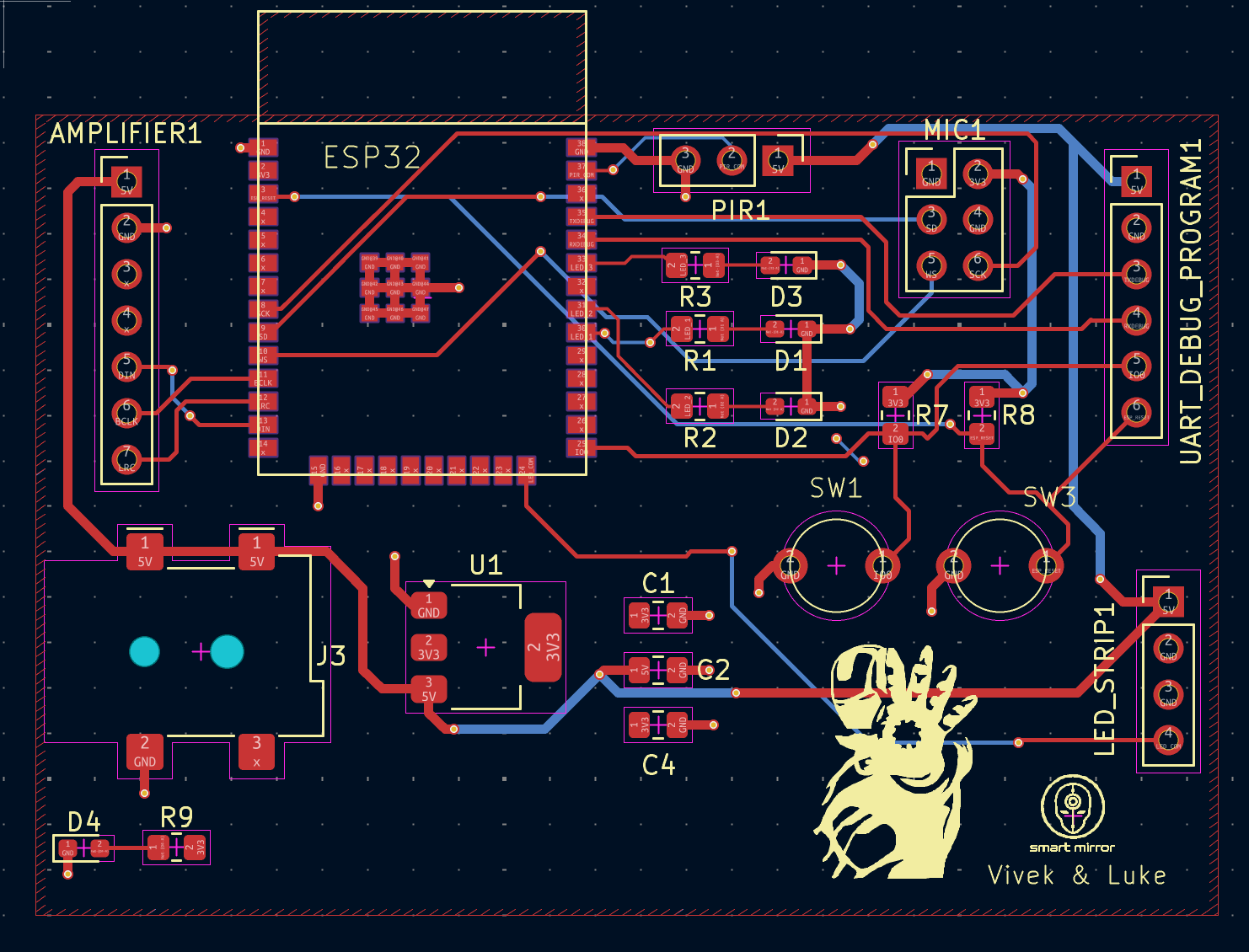
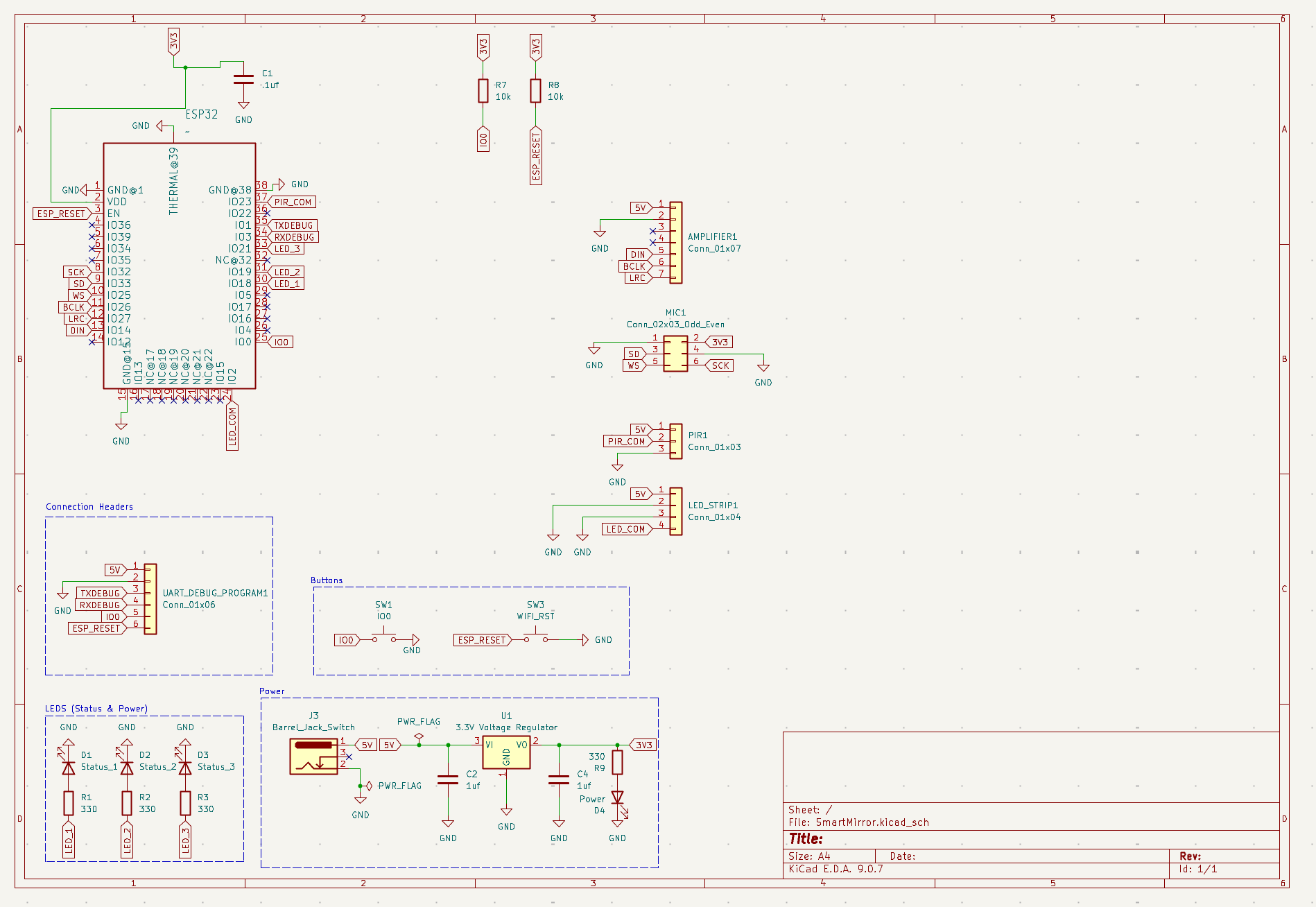
After evaluating a Raspberry Pi architecture, we moved the design to an ESP32 because its built-in Wi-Fi met the system's cloud-connectivity needs without requiring on-device AI. We integrated a PIR motion sensor, microphone, speaker with a Class-D amplifier, WS2812B addressable LEDs, and a display interface, then designed a custom KiCad schematic and two-layer PCB to consolidate the electronics.
The board provides 5 V input and regulated 3.3 V power, ESP32 programming and debug access, I²S audio connections, PIR and LED headers, status indicators, reset and input controls, and decoupling around the major subsystems. During bring-up, we traced degraded speaker output to shared power and ground paths with the higher-current LEDs, highlighting the importance of power-domain planning and grounding in mixed-signal hardware.
At the documented integration milestone, the LED strip, PIR sensor, microphone, speaker, Wi-Fi, and AI path had been implemented, while display software, physical mounting, and user testing remained in progress.
Project Context
This two-person EE 327 project explored a practical, voice-first smart-home interface behind a two-way mirror. Our design process combined component selection, user interviews, embedded integration, PCB design, and iterative architecture changes.
Key Features
- ESP32 central controller with Wi-Fi connectivity for cloud APIs and AI services
- PIR-based presence sensing for automatic activation
- I²S microphone and Class-D-amplified speaker interfaces for voice interaction
- WS2812B addressable LED interface and three status indicators
- Custom KiCad schematic and routed two-layer PCB with programming and debug headers
- 5 V input, regulated 3.3 V rail, reset controls, and local decoupling
- User interviews used to prioritize simple, glanceable information and motion-triggered operation
Challenges
- Revising the original Raspberry Pi concept around an ESP32-based architecture
- Adding a Class-D amplifier after the speaker required more drive than the initial design provided
- Diagnosing power and ground coupling between noise-sensitive audio circuitry and high-current LEDs
- Balancing display information density with an uncluttered mirror experience
- Coordinating display software, PCB completion, and mechanical integration within the course schedule
Results
- Implemented and integrated the LED, PIR, microphone, speaker, Wi-Fi, and AI subsystems
- Completed a custom system schematic and routed PCB for the ESP32-based architecture
- Identified mixed-signal power integrity as the source of speaker interference during bring-up
- Collected user feedback that shaped motion activation, information hierarchy, and customization goals
- Documented remaining display, mounting, and user-testing work without overstating prototype completion