Project
Plug-In Solar Optimization
Co-built a portable solar-and-battery prototype with wireless ESP32 telemetry, production forecasting, and hourly cost-optimized discharge scheduling.
Technologies
Overview
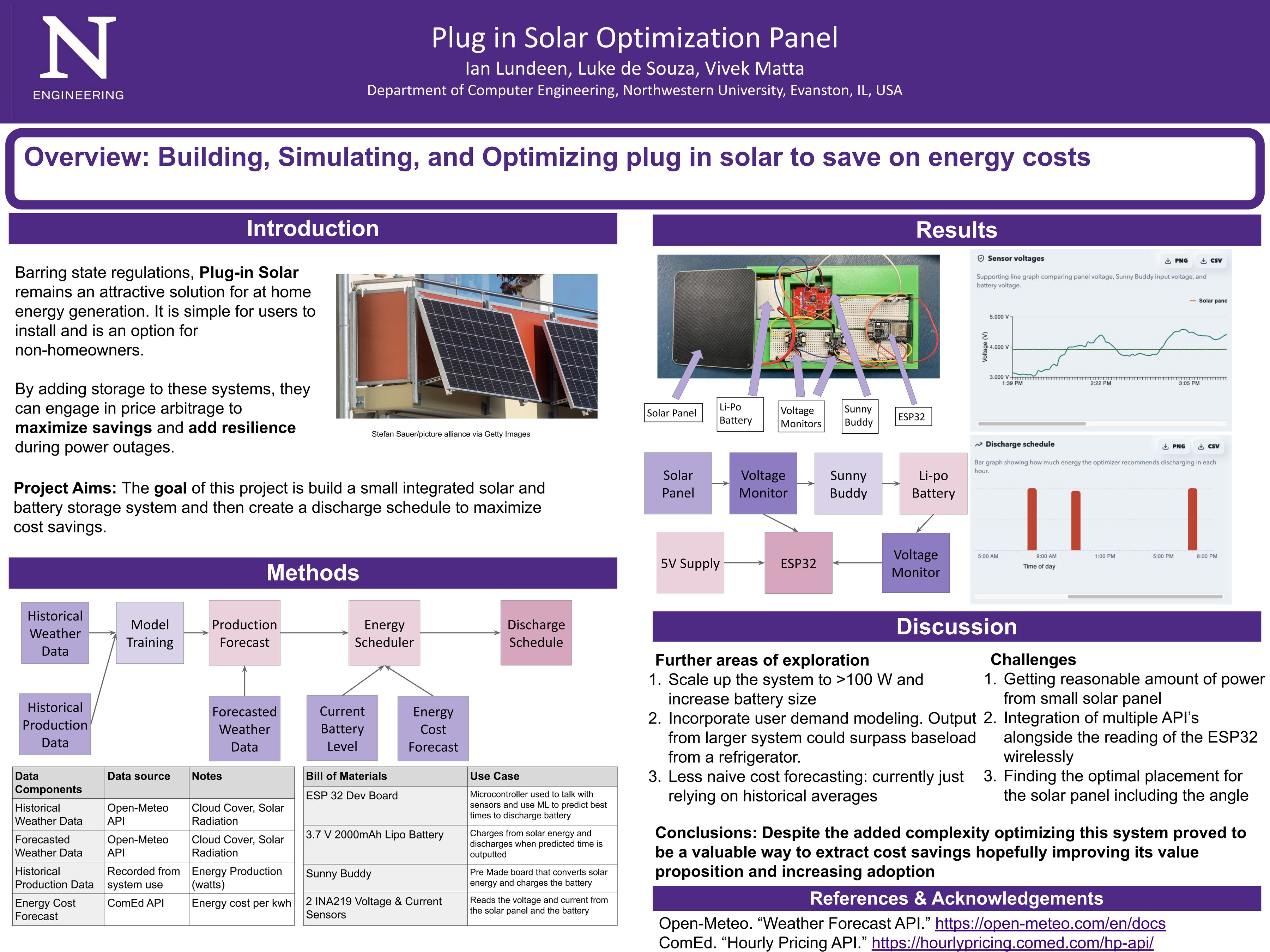
Co-developed a small-scale plug-in solar research prototype with Ian Lundeen and Luke de Souza for Northwestern University's COMP_ENG 395 Computing & Sustainability course. The project explored how portable photovoltaic generation and battery storage could lower the barrier to residential solar for renters and other users who cannot install a traditional rooftop system.
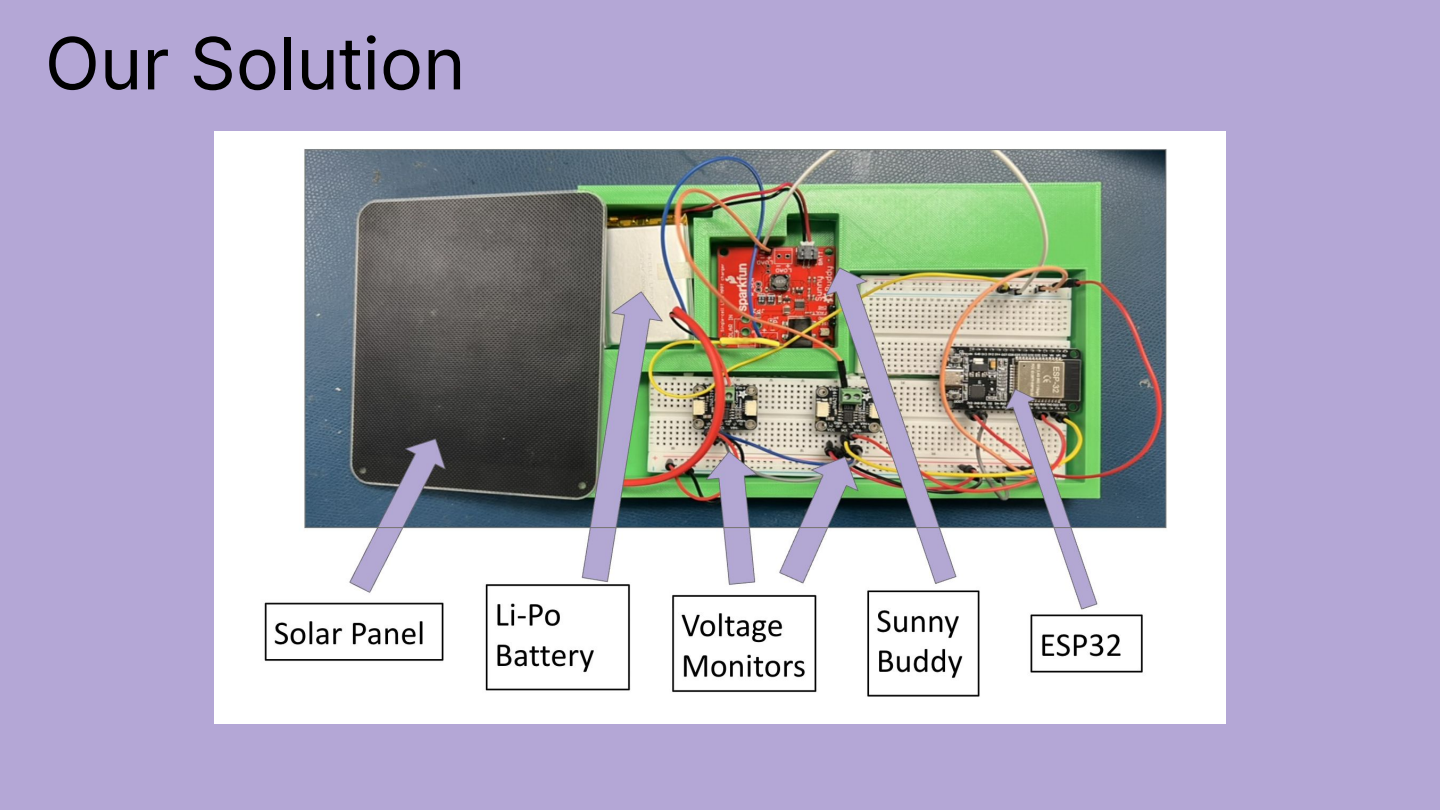
The hardware combines a 2 W, 6 V solar panel; a Sunny Buddy solar charger; a 3.7 V, 2000 mAh Li-Po battery; two INA219 voltage and current monitors; and an ESP32. One sensor measures panel production while the second tracks the battery. The ESP32 reads the hardware telemetry and sends it wirelessly to the software platform, and a custom 3D-printed case makes the breakout-board prototype easier to move while leaving the panel free for angle and placement experiments.
The software layer stores weather, production, and electricity-price data in Supabase. Open-Meteo supplies cloud cover and shortwave-radiation forecasts, while ComEd's pricing feed provides energy-cost data. A regression model forecasts hourly solar production from measured output and weather conditions, then a linear-programming scheduler selects battery-discharge times that maximize the value of stored energy while respecting charge, capacity, and hourly-discharge constraints.
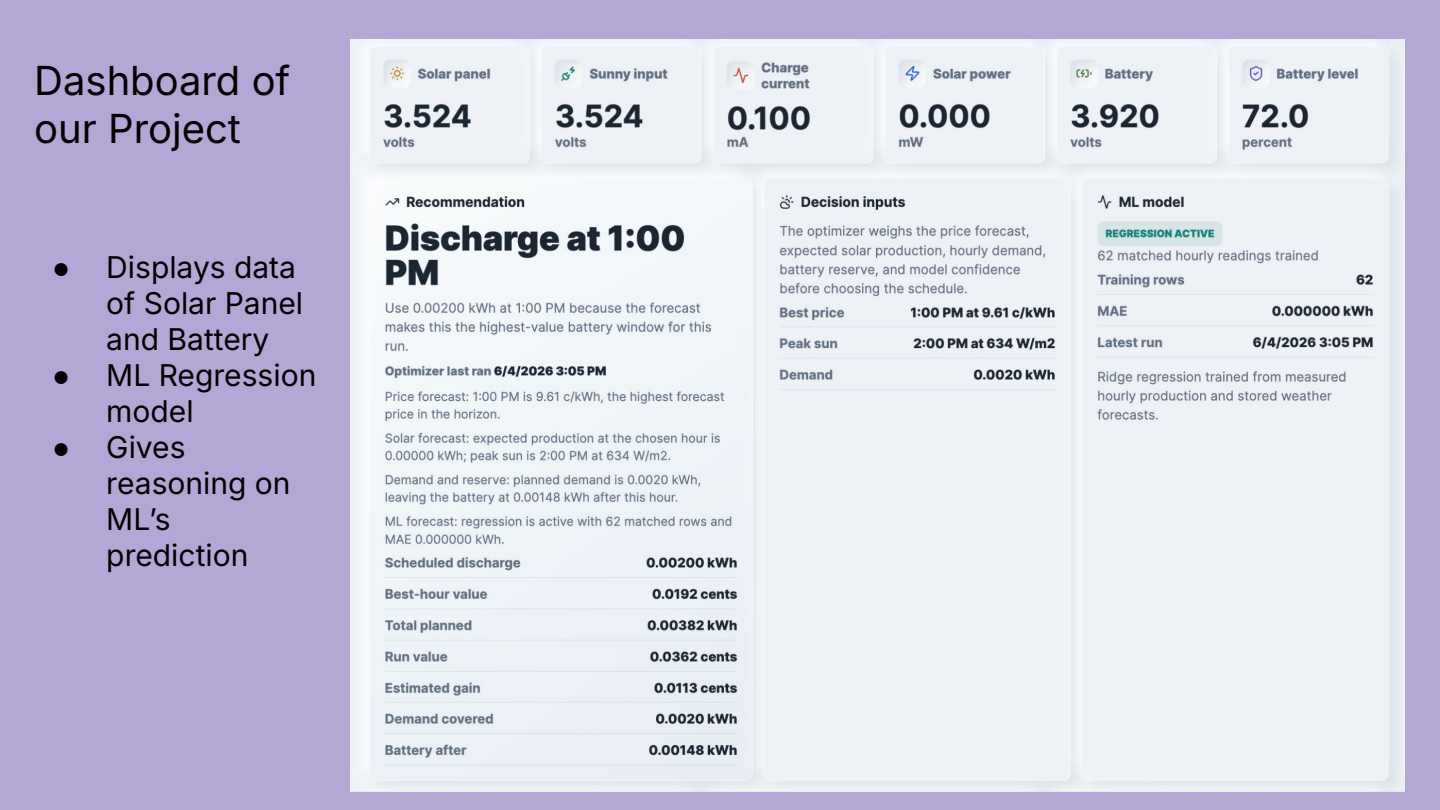
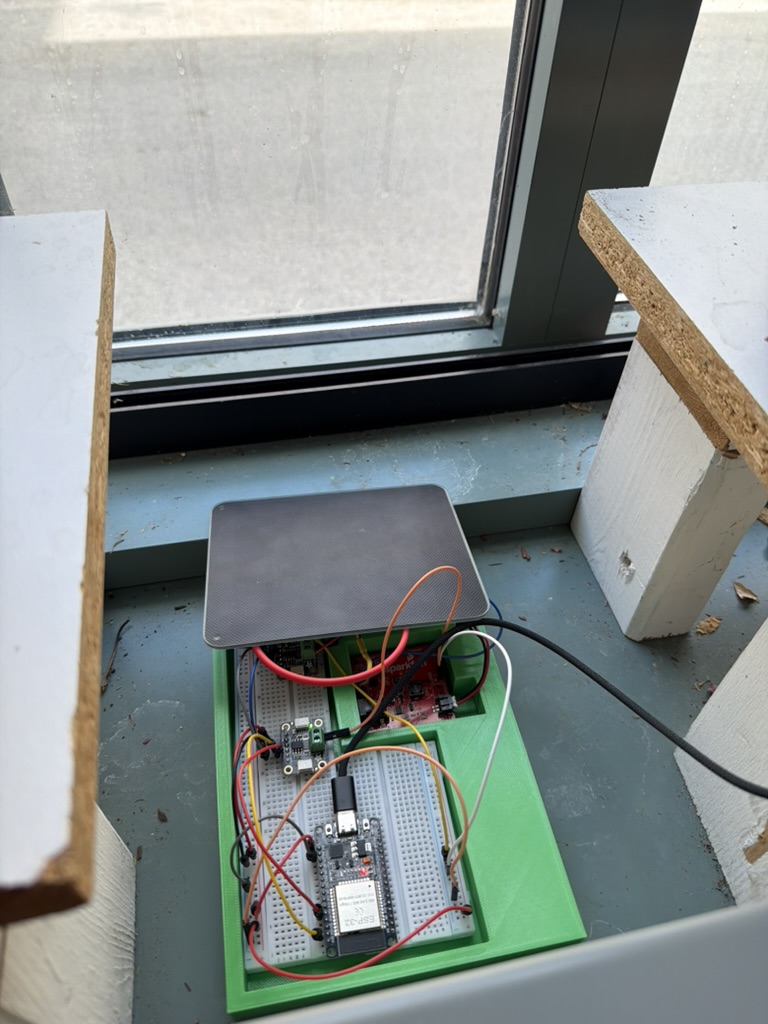
The completed prototype charged its battery from solar energy, monitored panel and battery voltage in real time, transmitted readings wirelessly, and displayed system state, forecasts, decision inputs, and discharge recommendations in a web dashboard. We gathered production data with the portable system positioned by a window and adjusted panel placement to find useful light conditions. Tests showed the schedule shifting with weather and price conditions, including discharge recommendations near higher-value morning and evening periods on sunny days.
Project Context
This three-person sustainability project combined physical energy harvesting, IoT telemetry, cloud data, forecasting, optimization, and a web interface. The result was a portable test platform for studying how battery storage can improve the economics of small residential solar systems.
Key Features
- 2 W, 6 V photovoltaic panel charging a removable 3.7 V, 2000 mAh Li-Po battery
- Sunny Buddy charging stage and dual INA219 voltage/current monitoring
- ESP32-based wireless telemetry for panel production and battery state
- Supabase storage for measured production, weather, and energy-cost data
- Open-Meteo cloud-cover and shortwave-radiation forecasts for Evanston
- ComEd electricity-pricing integration with hourly price aggregation
- Regression-based hourly solar-production forecast
- Linear-programming scheduler constrained by battery capacity and discharge limits
- Web dashboard explaining telemetry, forecasts, and discharge decisions
Challenges
- Generating useful energy from a small panel under variable indoor and outdoor light
- Modifying a nonstandard solar-panel connector for safe prototype integration
- Calibrating two sensing paths for panel production and battery state
- Combining wireless ESP32 measurements with multiple external APIs
- Finding panel placement and angle that produced meaningful test data
- Determining an economically optimal discharge time from changing forecasts
Results
- Built a functional solar charging and Li-Po battery-storage prototype
- Monitored panel and battery voltage in real time and transmitted measurements wirelessly
- Integrated measured production with Open-Meteo weather and ComEd price data
- Generated hourly production forecasts and cost-optimized discharge schedules
- Visualized system telemetry, model status, decision inputs, and recommendations in a web dashboard
- Packaged the electronics in a portable 3D-printed enclosure and collected production data during windowsill placement tests