Project
DIY "Bop It!"
Co-developed a handheld Micro:bit game that combines four physical actions, spoken commands, adaptive timing, and a custom 3D-printed enclosure.
Technologies
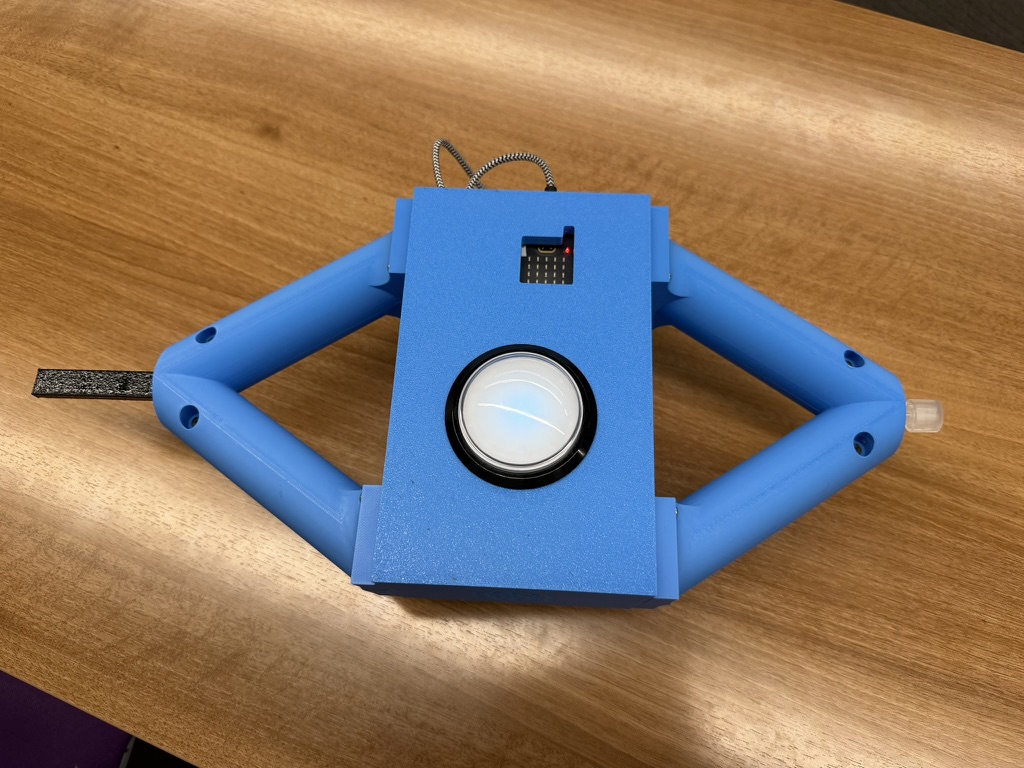
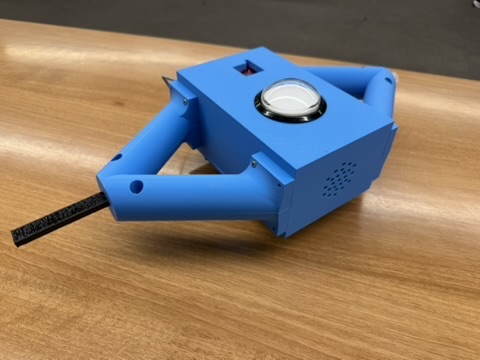
Overview
Co-developed a portable, sensor-driven take on the classic Bop It game for Northwestern University's CE346 Embedded Systems course. The finished device packages a Micro:bit, speaker, arcade button, flex sensor, rotary encoder, and microphone inside a custom 3D-printed enclosure designed to be held and played as a single unit.
The game issues a randomized spoken command and opens a timed input window for one of four actions: press the arcade button for “Bop it,” bend the flex sensor for “Bend it,” turn the Qwiic Twist rotary encoder for “Twist it,” or use the Micro:bit's built-in microphone for “Shout it.” Correct responses advance the score, while a missed or incorrect action ends the run. The command cadence increases as the player progresses to create an adaptive difficulty curve.
Justin Ansell and I shared responsibility for hardware configuration, embedded software, enclosure assembly, and testing. We validated each input independently before integrating the main game loop, then worked through audio-memory limits, command-to-input synchronization, reliable sensor thresholds, and mechanically secure component mounting.
Project Context
Built with Justin Ansell for Northwestern's CE346 Embedded Systems course, this project turns four different sensing methods into a cohesive handheld game. It combines timed embedded control, audio feedback, physical interaction, and enclosure design in one playable prototype.
Key Features
- Four-command interaction model: Bop, Bend, Twist, and Shout
- Arcade button, flex sensor, Qwiic Twist rotary encoder, and built-in Micro:bit microphone
- STEMMA speaker for spoken commands and gameplay feedback
- Timed input windows, score tracking, and progressively faster command cadence
- Custom 3D-printed handheld enclosure with integrated controls and speaker ventilation
- GPIO and I²C interfaces coordinated through an embedded game loop
Challenges
- Fitting command and transition audio within the Micro:bit's available memory
- Synchronizing speaker playback with the start and end of each input window
- Tuning distinct validation logic and thresholds for four different input types
- Mounting the flex sensor and wiring so repeated gameplay would not damage components
- Packaging the electronics into a portable enclosure without obstructing interaction
Results
- Produced a complete handheld prototype with all planned controls integrated into the enclosure
- Connected spoken commands, timed response validation, scoring, and increasing difficulty into one gameplay loop
- Completed the hardware, embedded software, assembly, and testing as a two-person collaboration